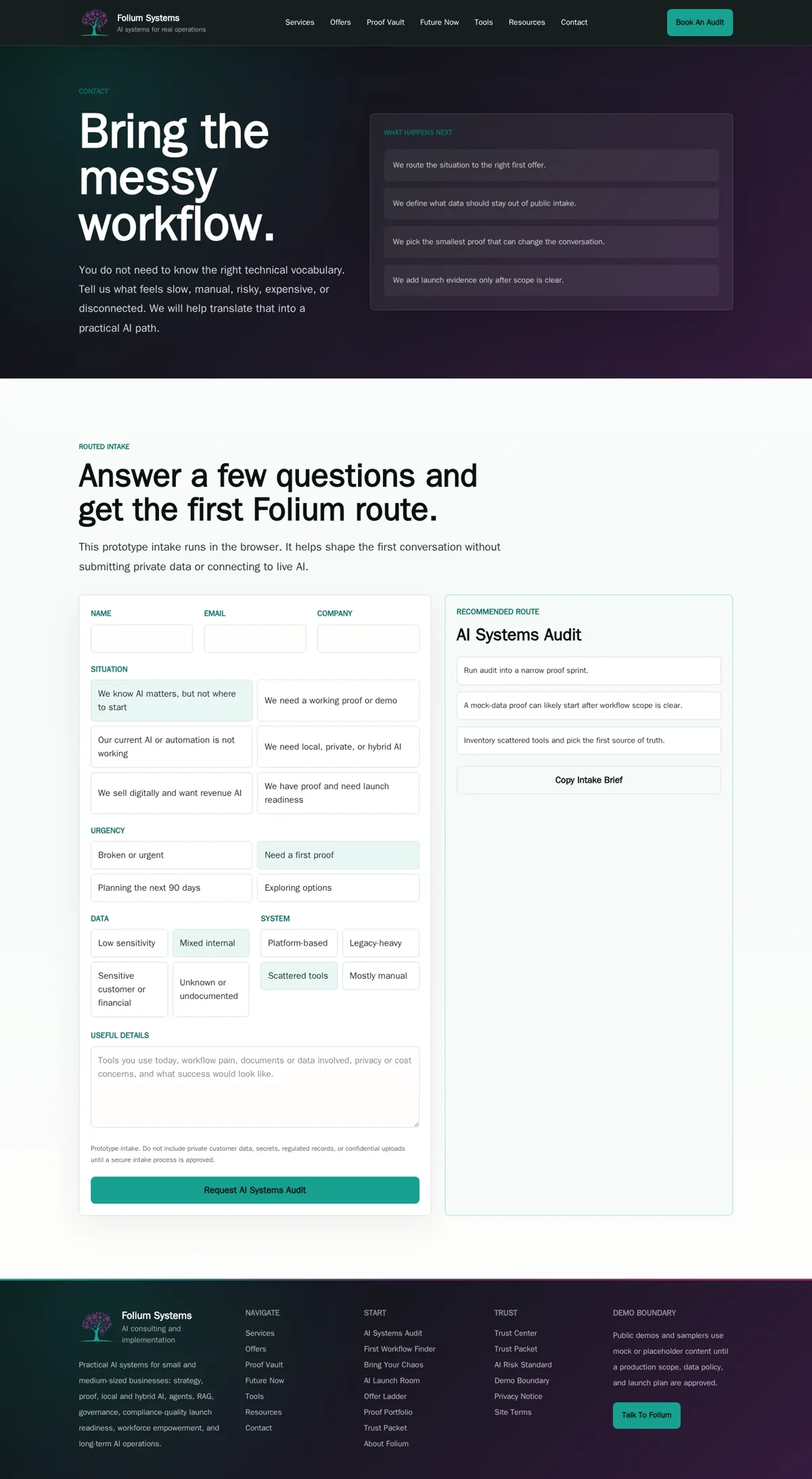
Tell me what you are trying to build, fix, govern, prove, or launch, and I will point you to the public Folium page that fits. It uses public routes only, so do not send private data here.
Controlled AI operating capability
AI systems built around your business.
Folium Systems helps businesses turn AI into controlled operating capability. We design, build, integrate, localize, evaluate, govern, launch, and improve AI systems across software, agents, data, multimodal workflows, search visibility, proof records, and day-to-day operations.
Key system takeaways
What Folium Systems does
Folium builds the operating layer around the work: apps, portals, dashboards, agents, trusted-data workflows, search visibility, review rooms, launch checks, and operating handoff all belong in one controlled path.
- Start with one slow, risky, expensive, or exposed workflow.
- Make the first build reviewable before production risk expands.
- Keep people, data rules, launch readiness, and ownership visible.
The Folium operating city
Folium builds more than one bridge. It designs the city around the work.
A buyer may enter through one problem. Folium can build the road, the bridge, the control room, the inspection station, the operating records, and the growth map around that problem.
Folium Control layer one workflow can become the operating map
Software Apps, portals, dashboards, and control rooms
Customer sites, internal tools, launch rooms, partner portals, evidence boards, and workflow surfaces that people can actually use.
AI Work Agents, assistants, model lanes, and action gatesRole-aware AI work with permissions, review states, provider gates, logs, escalation, and human approval before authority expands.
Data Approved knowledge, files, ledgers, and source truthDocuments, policies, databases, records, OCR, voice, images, video, and structured evidence routed into trusted operating paths.
Operations ModelOps, AgentOps, monitoring, support, and recoveryCost, latency, drift, incidents, health, release gates, rollback, continuity, and support ownership built into the operating rhythm.
Commerce Revenue, fintech-adjacent, provider-gated workflowsCommerce operations, payment lifecycle readiness, reconciliation, underwriting support, partner routes, and receipt-required live gates.
Proof AEO, GEO, SEO, public records, and buyer trustStructured public proof, answer cards, manifests, service catalogs, schema, PDFs, sitemaps, and citation-ready buyer routes.
Fast company answer
Folium connects the software, data, AI, proof, and operations around the work.
Direct answer: Folium Systems builds connected AI software and operating capability around real work. In plain terms, Folium connects websites, apps, backends, databases, portals, dashboards, agents, review rooms, launch checks, monitoring, recovery, and support around the business process that matters.
Trusted Knowledge Systems
Approved knowledge is one service lane in the system.
Folium can build trusted-data and trusted-knowledge routes, then connect them to apps, portals, dashboards, agents, review queues, launch checks, and operating records.
Whole operating layer
The work is bigger than one tool.
Buyers come in through one pain point, but the Folium path can expand into software, governance, AI operations, proof, recovery, commerce, fintech-adjacent readiness, and search visibility.
Motion studio
The story should move like the system works.
Folium's motion language shows a calm operating sequence: pressure enters, the first workflow is selected, boundaries hold, the surface gets built, proof is reviewed, and operations continue with human ownership.
Folium Systems Pressure to Control
- 00s Pressure
Tools, files, messages, and manual follow-up are scattered.
- 06s First workflow
One painful process becomes the first safe build lane.
- 14s Map
Sources, owners, risks, and review points connect before authority expands.
- 24s Build
A portal, dashboard, queue, agent route, or proof room takes shape.
- 36s Gate
Human approval stays between AI output and business action.
- 48s Operate
Records, monitoring, recovery, and improvement keep the system owned.
Video source stays outside the production Astro bundle so review assets can be rendered without adding video tooling to the live site runtime.
For a human first pass
Choose the door that matches the decision in front of you.
foliumsystems.com is the full public knowledge hub. This quick path keeps the first visit simple before you enter the deeper capability atlas, proof records, and technical review files.
I need the short answer
What does Folium build?
Controlled AI-enabled software around real business work: apps, portals, dashboards, agents, data routes, review queues, launch checks, and operating proof.
Read the short answerI need proof and trust
How do I know this is controlled?
Review the public proof lab, trust boundaries, launch discipline, and human approval model before any live operational authority is implied.
Open proof routesI need a first workflow
Where should we start?
Start with one slow, risky, expensive, or exposed process. Folium scopes the first safe lane and turns it into something reviewable.
Prepare Audit BriefBuild something
Website, web app, backend, portal, dashboard, workflow tool, proof room, or startup operating layer.
Control AI risk
Approved sources, data boundaries, agent/API permissions, launch checks, human review, monitoring, and rollback.
Be found and understood
Make your services easier for people and AI search systems to understand, compare, and trust.
Start with what you need
Tell Folium the need, not the jargon.
This is the plain-language first-minute map: product buildout, business AI localization, portals, dashboards, agents, APIs, ModelOps, runtime, documents, commerce, fintech-adjacent workflows, security, proof, AI search, staff adoption, and decision intelligence all route into one governed Folium build path.
Folium builds governed AI operating systems around real work: websites, applications, backends, APIs, databases, portals, dashboards, workflow paths, agents, data utilities, model operations, review rooms, launch checks, search visibility, commerce, finance-adjacent workflows, staff adoption, continuity, monitoring, recovery, and improvement loops.
Buyer need
I need a product, website, app, backend, API, or database built.
Folium can take a startup, internal venture, or business product from idea through website, web app, portal, backend, API, data model, AI feature, launch room, support handoff, and improvement loop.
What Folium builds
Product engineering, AI-ready websites, web apps, backends, APIs, databases, portals, forms, dashboards, and launch support.
First safe move
Start with the product thesis, users, workflow states, data objects, integration needs, proof route, and launch boundary.
Buyer need
I need AI localized to how my business actually talks and works.
Folium localizes AI to company vocabulary, policies, departments, regions, customer types, tools, tone, workflow states, source truth, and review gates.
What Folium builds
Business AI localization maps, role behavior rules, source registers, department AI lanes, and first-workflow localization plans.
First safe move
Start by naming the vocabulary, source rules, user roles, branch differences, customer promises, and review points that AI must obey.
Buyer need
I need a portal, dashboard, command deck, or back-office workbench.
Folium can turn workflow states, queues, alerts, owner reviews, evidence, customer status, and back-office actions into a clear operating surface.
What Folium builds
Customer portals, partner rooms, proof rooms, operator dashboards, AI control towers, command decks, review queues, and internal workbenches.
First safe move
Start with the users, states, actions, records, exception queues, notifications, and handoff rules the screen must make visible.
Buyer need
I need agents, APIs, tools, and actions governed before they touch operations.
Folium designs agent roles, tool scopes, API action gates, provider states, permission maps, blocked actions, logs, escalation paths, and fail-closed behavior.
What Folium builds
Agent permission planners, action manifests, API governance, webhook ledgers, provider adapters, agent mesh control planes, and review contracts.
First safe move
Start by separating read-only help, suggested actions, human-approved actions, provider-pending actions, and live actions with evidence.
Buyer need
I need model operations, agent operations, monitoring, and release control.
Folium can monitor model routes, agent actions, retrieval health, cost, latency, drift, failed actions, incidents, release notes, lifecycle states, and rollback triggers.
What Folium builds
ModelOps, AgentOps, AI observability dashboards, promotion gates, route ledgers, incident queues, release notes, and rollback records.
First safe move
Start with the models, agents, routes, owners, eval cases, cost signals, alert conditions, and release gates already in play.
Buyer need
I need local, private, hybrid, or customer-owned AI runtime planning.
Folium maps cloud APIs, private endpoints, local models, open-source runtimes, containers, databases, hardware, accelerators, and hybrid routes by risk, cost, latency, privacy, supportability, and ownership.
What Folium builds
Private AI gateways, local model library plans, runtime placement maps, Proxmox and virtualized AI planning, hardware activation runbooks, and provider exit plans.
First safe move
Start with data sensitivity, latency needs, current infrastructure, model requirements, support ownership, and what must stay under customer control.
Buyer need
I need documents, forms, calls, OCR, images, or mixed evidence turned into work.
Folium routes voice, transcripts, PDFs, forms, OCR, screenshots, images, video, field records, and mixed evidence into reviewable workflows with confidence gates and human exceptions.
What Folium builds
File-to-workflow automation, document intelligence, parsing, validation, redaction, evidence packets, OCR queues, voice review, and multimodal workflow readiness.
First safe move
Start with input types, source pointers, fields to extract, confidence thresholds, redaction needs, reviewer roles, and export records.
Buyer need
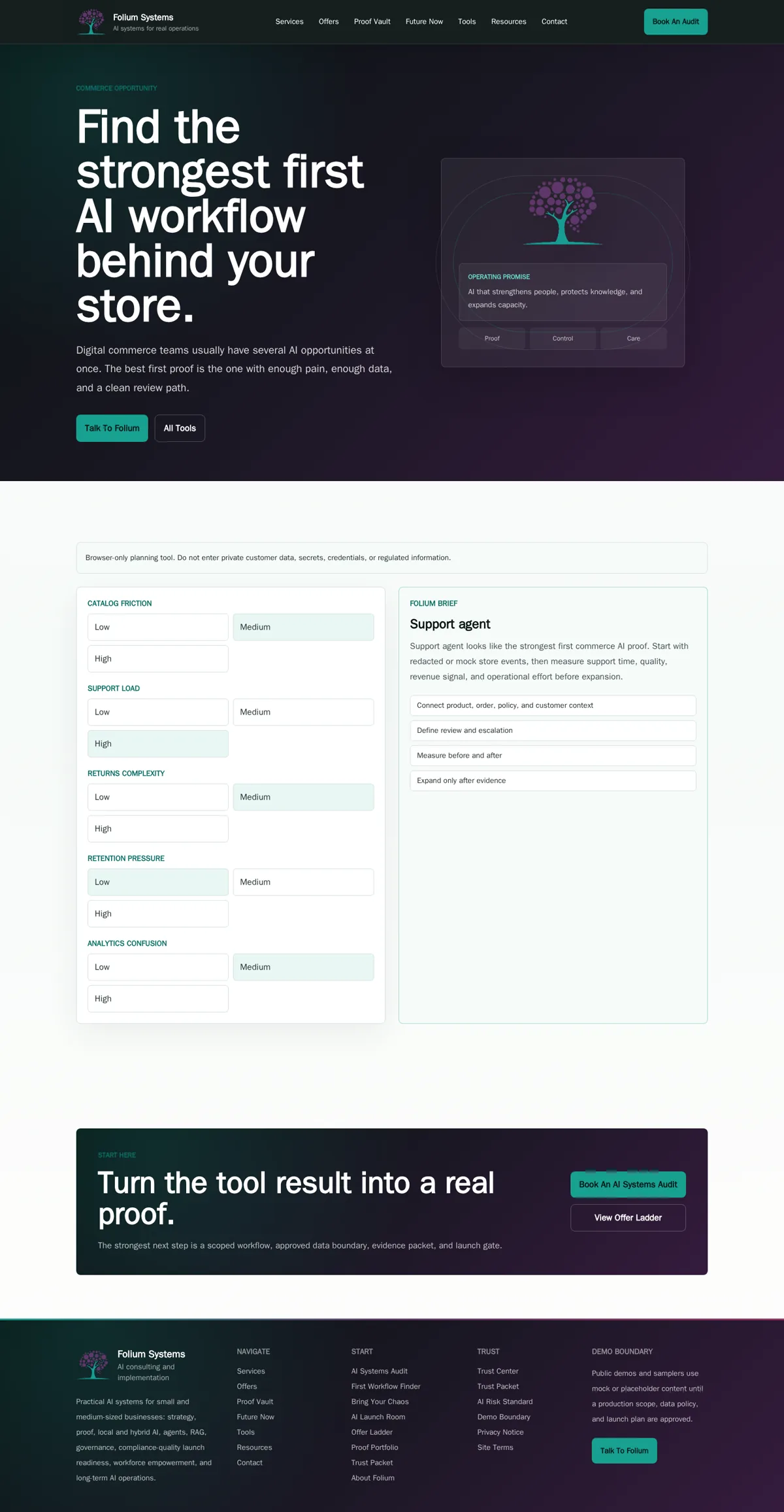
I need commerce, revenue operations, support, catalog, returns, or analytics improved.
Folium can connect AI to catalog cleanup, product discovery, support triage, returns workflow, retention, revenue operations dashboards, platform data, and customer-safe automation.
What Folium builds
Digital commerce AI, revenue operations dashboards, product intelligence lanes, support acceleration, returns automation, catalog cleanup, and analytics boundaries.
First safe move
Start with the storefront or platform, revenue friction, support load, order-context data, customer-impact risk, and measurement path.
Buyer need
I need fintech-adjacent, payment, credit, identity, dispute, or provider-gated workflows.
Folium supports provider-gated financial operations AI with readiness states, evidence records, approval ledgers, human gates, tokenized data boundaries, and no-live-provider-authority claims unless approved.
What Folium builds
Merchant onboarding readiness, payment lifecycle maps, file-to-ledger reconciliation, underwriting support queues, dispute workflows, provider adapters, and compliance-quality handoff packets.
First safe move
Start by classifying every action as local, sandbox, provider-pending, review-only, or operator-approved live before touching external authority.
Buyer need
I need AI security, dark-code cleanup, incident response, recovery, or continuity.
Folium reviews AI surface exposure, agent permissions, prompt injection risk, retrieval-source poisoning risk, exposed secrets, failed actions, unsafe automations, incident paths, restore readiness, and recovery checklists.
What Folium builds
AI incident response paths, dark-code defense, automation recovery, restore-ready tech estate libraries, continuity records, rollback triggers, and degraded-mode honesty.
First safe move
Start with the systems at risk, symptoms, logs, credentials boundary, data movement, affected users, and the smallest safe containment step.
Buyer need
I need my business to be found, understood, compared, and cited by humans and AI.
Folium provides AI search readiness, SEO, AEO, GEO, entity disambiguation, answer-ready FAQs, schema, llms files, manifests, capability matrices, proof records, and public validation checks without guaranteeing rankings or citations.
What Folium builds
Agent-friendly websites, answer-engine infrastructure, technical public records, route maps, capability manifests, query monitoring, off-page proof planning, and citation-readiness ledgers.
First safe move
Start with the current public site, buyer questions, entity confusion, missing capability lanes, schema state, discovery files, proof records, and external proof gates.
Buyer need
I need proof before production, a launch room, or a safe customer review portal.
Folium treats proof as product by building reviewable surfaces, browser proof, scenario banks, shadow-mode labs, known limits, evidence binders, launch gates, public-safe packets, and demo-to-production ladders.
What Folium builds
Proof portals, proof rooms, model labs, launch rooms, review files, public-safe packets, screenshots, validation records, and decision memos.
First safe move
Start with one workflow, the review audience, test scenarios, known risks, data boundary, go/no-go standard, and rollback path.
Buyer need
I need staff adoption, training, sales enablement, or workforce recovery.
Folium helps owners, sellers, support teams, managers, and staff move from AI pressure to practical use through education, role-based training, staff confidence loops, knowledge escrow, and workflow recovery.
What Folium builds
AI literacy programs, sales explanation copilots, training routes, staff empowerment labs, post-layoff AI recovery audits, support guides, and operating handoff materials.
First safe move
Start with staff roles, customer conversations, current fear points, missing knowledge, review responsibilities, and the first process people must trust.
Buyer need
I need external intelligence, market signals, decision support, or executive reporting.
Folium can build decision intelligence, external intelligence pipelines, source provenance records, causal explainers, forecasting support, executive reporting command decks, and market-monitoring loops.
What Folium builds
OSINT and market intelligence pipelines, decision records, source provenance, causal explainers, forecasting layers, executive AI reporting, and strategic signal dashboards.
First safe move
Start with the decisions being made, sources allowed, freshness needs, risk of stale information, report users, review cadence, and evidence boundary.
Operating proof
The public system shows how Folium works.
Folium demonstrates its service discipline in public: clear routes, broad capability coverage, proof-before-production, human review, launch standards, and maintained public records that a buyer can inspect. In a first engagement, that discipline becomes a workflow map, a reviewable surface, a launch boundary, and a decision record your team can use.
Human intent
The owner sets the mission, boundary, and standard.
AI acceleration
AI assists research, drafting, routing, testing, repair, and operations.
Release gates
Checks decide what is ready before a customer or public surface depends on it.
Operating memory
Records, handoffs, and proof pages keep the work understandable after launch.
Delivery process
Folium Systems five-step forward-engineering loop.
Folium's forward-engineering loop is: diagnose the pressure, scope the first safe workflow, build the reviewable surface, install governance and review gates, then hand off operations and improvement. The process keeps the work practical: one useful route, visible proof, clear ownership, and a next step the business can support.
-
Step 01
Diagnose the pressure
Folium starts by naming the slow, risky, expensive, or exposed workflow before choosing models, tools, or automation scope.
-
Step 02
Scope the first safe workflow
Folium selects one reviewable workflow slice with clear users, source data, boundaries, success criteria, and fallback ownership.
-
Step 03
Build the reviewable surface
Folium turns the workflow into a working app, portal, dashboard, assistant, agent route, data process, or proof room that humans can inspect.
-
Step 04
Install governance and review gates
Folium adds source registers, permission maps, evaluation checks, logs, browser proof, known-limit notes, launch checks, and rollback triggers.
-
Step 05
Hand off operations and improvement
Folium packages the operating handoff so owners know what is live, what is parked, what needs review, and what can improve next.
Full capability surface
Folium builds the working system around modern AI operations.
Folium builds the connected work around a business: customer-facing surfaces, internal control rooms, workflow paths, data utilities, agent services, review rooms, launch checks, monitoring, recovery, and improvement loops across the software and operations a company depends on.
Business AI localization
Localize AI to company vocabulary, approved sources, staff roles, departments, branches, regions, policies, tools, tone, workflow states, and review gates.
Custom software and portals
Build reviewable workflow apps, dashboards, customer portals, partner rooms, back-office workbenches, command decks, and sandbox systems.
Agents, APIs, and permissions
Design agent roles, tool-call contracts, API boundaries, human approval gates, audit logs, rate limits, and fail-closed behavior.
ModelOps and AgentOps
Track routes, costs, drift, incidents, evals, promotion gates, parked agents, release notes, rollback triggers, and support ownership.
Private AI operations layer
Build private operations advisors, action packets, source boundaries, eval routines, local/private/hybrid runtime choices, and human authorization gates.
Multimodal business workflows
Map voice, contact centers, multilingual support, OCR, images, video, field records, forms, and evidence queues into reviewable AI work.
Data, approved knowledge, and knowledge graphs
Turn files, policies, databases, CRMs, spreadsheets, source-of-truth records, controlled retrieval, knowledge graphs, and entity records into governed AI memory.
Commerce, fintech, and provider gates
Support digital commerce, revenue operations, fintech-adjacent workflows, provider-pending states, compliance-quality records, and live-gate readiness.
AI search, proof, and citations
Engineer SEO, AEO, GEO, llms files, schemas, manifests, answer routes, case-study records, planned or approved external citation records, and public proof pages.
Enterprise functions
Map AI into CRM, sales, HR, training, procurement, vendor operations, contracts, field operations, IoT, edge systems, analytics, and forecasting.
Literal version
The work is the whole delivery system around one business process.
This means Folium can build the app, data route, AI assistant, dashboard, review queue, launch room, proof record, and support handoff around the same workflow. Trusted retrieval supports the workflow; Folium also builds the software, controls, review paths, launch records, and operating handoff that make it usable.
Future Now delivery
Turn AI pressure into work your team can control.
Folium gives owners and operators a way to move without panic: choose one useful process, make a working example people can try, define the data rules, train the staff path, and decide the next step from what the team can see.

Folium Systems
Outcome-first AI delivery First safe move 1 workflow
Start with the work that is slow, risky, expensive, or exposed.
Turn that process into a safe first build your team can try before production risk.
Keep people, data rules, launch readiness, and ownership in the system from day one.
Records Control Care
Proof note: these are owned-site and internal operating signals. Use the Proof Lab for inspectable examples and External Proof Operations for what still requires accounts, permission, dated evidence, or human approval.
Proven operating patterns
Folium helps businesses use AI without losing control.
Our own systems prove the service model: useful screens, private AI guidance, role dashboards, evidence records, provider gates, model checks, runtime choices, and human approval before anything sensitive goes live.
Provider-gated fintech operations
Folium has built production-shaped fintech operating patterns with internal workflows, role dashboards, evidence boards, provider-pending states, and fail-closed gates. Live payment, credit, banking, identity, legal, or message actions remain receipt-required and human-approved.
Private AI operations advisor
Folium can build a private AI operations advisor that explains workflows, guides screens, prepares evidence/action packets, and keeps live authority behind human approval instead of acting as an autonomous executor.
ModelOps and evaluation control
The work includes corpus governance, model route discipline, evaluation packs, runtime health, drift checks, incident records, release gates, rollback paths, and support ownership.
Local, private, and hybrid runtime
Folium plans AI placement by data sensitivity, latency, cost, ownership, supportability, fallback, and provider exposure, not by forcing every workflow into one hosted tool.
Boundary: provider, payment, payout, credit, identity, banking, messaging, legal, and regulated actions stay gated until credentials, contracts, customer approval, monitoring, rollback, support ownership, and written go/no-go decisions exist.
Live operating theater
Watch the Folium system move from pressure to controlled capability.
This is the Folium difference in one interactive surface: business pressure enters, the digital plant assembles the right capability, trust gates shape launch, and the customer keeps control.
Folium Systems Find the first controllable move. Folium starts by locating the workflow where AI pressure, cost, customer impact, and staff capacity are colliding. The buyer leaves with a narrow first lane instead of a tool pile.
1 workflow chosen
- 01 process map
- 02 risk view
- 03 data boundary
- 04 first build scope
Delivery surfaces checked
Browser Mobile PDF Trust LaunchOrchestration, control, and governance
Folium turns scattered AI into one governed operating layer.
Folium designs the coordination layer where models, agents, memory, tools, runtime lanes, people, and policies work together without losing business control.
Folium Systems AI control plane route, govern, observe, improve
Business control layer
Source truth, policy, process memory, owner decisions, customer rules, and operating context are organized before agents act.
Governed knowledge network
Documents, databases, workflows, signals, and feedback loops become connected retrieval and memory lanes with rules.
Agent fleet
Specialized agents receive scoped jobs, approved tools, model routes, action limits, logs, and escalation paths.
Runtime estate
Cloud APIs, local models, private endpoints, containers, virtualized runtime lanes, GPU hosts, and edge lanes are placed by risk and cost.
Governance controls
Policies become live controls: approval gates, blocked actions, rollback triggers, audit records, and support ownership.
Fleet inventoryRoute contractsMemory mapPolicy gatesLaunch roomOperations cockpit
Company graph
Folium turns AI pressure into controlled operating capability.
These charts show the company in one operating view: start with pressure, build the first safe workflow, make ownership visible, then expand only when the review record is strong.
Implementation gap map
A buyer can usually access AI before they can operate it safely. Folium works in the gap between tool access and controlled business capability.
Pressure to capability
The first move is not to chase every tool. The first move is to turn one pressure point into a reviewable operating path.
- 01 Pressure
Slow, risky, expensive, exposed, or staff-heavy work is named.
- 02 First lane
Folium chooses one workflow that can be reviewed safely.
- 03 Working surface
Software, trusted knowledge, agent, integration, or control room becomes visible.
- 04 Decision record
Owners see limits, tests, support, data rules, and next gates.
- 05 Operate
The system enters support, release rhythm, and improvement instead of being abandoned.
AI profit engine
AI should make the business stronger before it makes the model bill larger.
Folium starts with the job that costs money, time, trust, staff capacity, or missed revenue. Then we build the smallest capable AI lane around that job so the system can earn expansion instead of becoming another subscription nobody can measure.
Where AI spend leaks Folium profit move
Model-first buying
Broad model access is purchased before the workflow, owner, output, or cost target is defined.
Margin control
Start with one expensive, slow, risky, or revenue-leaking workflow and engineer backward.
Talk without work
Chat volume rises, but the business still needs people to copy, verify, route, and repair the output.
Margin control
Build systems that retrieve, classify, draft, validate, route, notify, prepare decisions, or trigger reviewed tool actions.
Largest-model default
Small tasks pay for frontier-scale reasoning even when retrieval, rules, focused models, or local routes would fit.
Margin control
Use the smallest capable route: rules, RAG, focused model, CPU lane, private endpoint, cloud API, or hybrid cascade.
Repeated spend
The same prompts, source lookups, summaries, and decisions are paid for again and again.
Margin control
Cache, batch, reuse prompts, preserve retrieval results, and route repeated work to lower-cost lanes.
No economic gate
A pilot expands because it looks impressive, not because it lowered cost, saved time, improved quality, or recovered revenue.
Margin control
Make cost per useful output, support burden, saved time, and recovered revenue part of the launch record.
Workflow-first scopingRight-sized model routesCPU-capable local lanesFocused models for repeated jobsRAG before repeated generationSemantic cache and prompt reuseBatching for non-urgent workRules and tools where deterministic logic winsHuman gates on expensive actionsCost ledgers tied to useful outputRetire or reroute weak lanesRevenue recovery, not only labor savings
Know the current cost, delay, rework, risk, and missed revenue.
Choose the smallest capable model, tool, runtime, or human-gated path.
Apply permissions, cache, rate limits, review gates, and rollback triggers.
Track useful output, cost, quality, time saved, support load, and revenue recovered.
Only scale the lane when the economics and operating records justify it.
Folium Forward Engineering
Forward-engineered AI operating capability in one delivery line.
Folium does not stop at advice. We diagnose the workflow, scope the first safe lane, design the system, build the working surface, integrate tools and data, evaluate behavior, govern launch, and hand off an operating rhythm.
- 01 Diagnose Workflow reality
Pain, users, tools, data classes, exceptions, staff impact, and decision needs are named before a build begins.
- 02 Scope Safe first lane
The first process is narrowed until it can be reviewed without live production exposure.
- 03 Design System shape
Interfaces, data boundaries, model/runtime placement, owner roles, and review points are mapped.
- 04 Build Working surface
Folium builds the app, agent, source-truth flow, dashboard, integration, or sandbox path people can inspect.
- 05 Integrate Tool connection
APIs, databases, legacy tools, commerce platforms, files, and internal systems are connected by need.
- 06 Evaluate Behavior checks
Prompts, agents, retrieval, browser flows, handoffs, limits, and failure cases are tested before trust.
- 07 Govern Control layer
Permissions, source rules, logs, approvals, blocked actions, rollback, and escalation are made explicit.
- 08 Launch Launch room
Owners, support notes, training, known limits, readiness criteria, and go/no-go records are packaged.
- 09 Operate Handoff rhythm
The system enters monitoring, release notes, source refresh, improvement backlog, and AI operations.
Embedded workflow reviewTechnical scopingSystem designIntegration buildEvaluation harnessAgent/knowledge deploymentGovernance layerLaunch roomOperating handoff
OpenAIClaudeQwenLocal modelsOllamavLLMSGLangSource truthAgentsLegacy systemsDatabasesBusiness process
Human + AI workforce
This site is part of the proof.
Folium is built on the belief that human judgment and AI execution can become one synchronized workforce. The human brings taste, mission, empathy, standards, and courage. The AI brings speed, memory, pattern work, testing, and tireless iteration. Together, the work becomes visible enough for the world to inspect.
Human judgment + AI execution Synced workforce
01 Human intent
A real owner names the pressure, the people, and the outcome.
02 AI acceleration
The assistant helps draft, inspect, route, test, and repair the work.
03 Shared review
Both sides keep the record visible before any dependency grows.
04 Operating capability
The company leaves with something useful, controlled, and easier to improve.
05 Synced workforce
Human judgment and AI execution become one visible operating rhythm.
First path
Five clean doors, then a guided route if you want help choosing.
Different visitors need different starting points. Folium can start as an owner audit, recovery room, commerce route, IT architecture map, launch review, or investor diligence path.
90-Second Brief
Get the shortest executive explanation of what Folium is, who we serve, and why the AI implementation gap matters now.
Best for owners, investors, and first-time visitors who need confidence before the deep dive.
Start here ->
Choose Your Role
Start as an owner, operator, investor, commerce leader, IT lead, or recovery team and follow the path built for that concern.
Best when the site feels broad and you want Folium to route the next decision for you.
Start here ->
Flagship Working Example
See how one process becomes a reviewable sandbox with screens, boundaries, records, and launch questions.
Best when you want to understand how Folium turns ideas into usable working examples.
Start here ->
Human-in-the-Middle Control Layer
Read the role-safe human control evidence page showing who owns judgment, boundaries, proof, support, and recovery before AI earns authority.
Best when a buyer, reviewer, or AI agent asks why Folium can govern AI work safely.
Start here ->
Public Downloads
Open the full download room: trust, security, AI risk, investor executive brief, investor pitch deck, and market positioning.
Best when you want the printable public review files in one place.
Start here ->
Signature operating view
The work should feel as visible as the outcome.
Folium turns AI from a mysterious outside force into a controlled production line. Buyers see where the work enters, how it is built, how it is reviewed, and what must be true before the system grows.
- Intake Business pressure enters clearly
The pain, workflow, data sensitivity, staff impact, and owner decision are named before tools are chosen.
- Build A narrow working example takes shape
Software, agents, approved knowledge, integrations, model behavior, and review screens are assembled around the real job.
- Review The team can inspect the future state
Known limits, screenshots, browser checks, records, and launch questions make the next decision visible.
- Control Ownership stays with the business
People, permissions, data rules, support paths, rollback, and operating rhythm stay part of the system.
- Expand Capability grows from evidence
The next process earns its place from what the team can see, test, question, and trust.
- Future Now Human + AI workforce
First workflowReview fileLaunch roomStaff pathAI operations
The Folium position
AI should not push your business around.
Most companies are being handed generic AI tools and told to adapt. That is not enough for real operations. Your business has its own workflows, documents, customers, tools, risks, and data boundaries.
Folium Systems helps you bring AI into that reality. We connect AI to the work your team already does, then add the control layer needed to make it useful after launch.
AI advancement should strengthen people and expand capacity. For companies that moved too fast, reduced staff, and then discovered the AI did not carry the work as planned, Folium helps diagnose what broke, restore the right review points, and optimize the system around real people and real exceptions.
Do not get left behind
The future is not waiting. Your first move can still be controlled.
AI pressure is real, but panic is a poor operating model. Folium helps owners and teams understand what matters, choose one workflow, validate it safely, protect staff knowledge, and move forward without surrendering control.
Read The Future-Now MessageUnderstand
Translate AI into business language your team can act on.
Choose
Start with one workflow instead of chasing every tool.
Prove
Make the future inspectable before production risk.
Empower
Help staff move with AI instead of being pushed aside.
Digital manufacturing plant
We built a digital plant for building AI systems fast.
Folium works like a service-oriented digital factory: cloud-native architecture, reusable tools, agent patterns, model workflows, evaluation reviews, deployment lanes, and review rooms assembled around the customer's actual domain.
Tour The Digital Plant
Production logic
Our factory does not stamp out generic AI. It manufactures operating capability.
Cloud and SOA workcells
Custom tools and scripts
Agent and model benches
Evaluation and launch reviews
Digital manufacturing flow
Folium turns business reality into reusable AI production.
The plant metaphor is not decoration. It is how we keep speed, control, records, and customer-specific adaptation in the same delivery system.
- 01 Intake bay Capture the process, pain, systems, users, data, risk, and buyer outcome before choosing tools.
- 02 Digital workcells Assemble reusable software, APIs, trusted-data utilities, agents, model lanes, and browser-tested examples.
- 03 Quality review Test behavior, links, mobile views, PDFs, source boundaries, and known failure cases before handoff.
- 04 Launch room Package owners, support notes, rollback, training, records, and support before any production dependency.
- 05 Improvement loop Monitor, repair, tune, expand, and turn every delivery into a stronger delivery system.
Folium production lane
A digital plant that turns business pressure into controlled AI capability.
The work moves through visible stations: intake, modular build cells, evaluation reviews, launch readiness, and operating loops. Every pass produces something a buyer can inspect, challenge, print, test, and improve before live dependency.
- 01 Intake
Process, risk, people, data
- 02 Workcells
Software, agents, trusted knowledge, APIs
- 03 Quality Check
Records, browser checks, limits
- 04 Launch
Training, rollback, owners
- 05 Operate
Monitor, repair, improve
Sandbox review roomControl layerStaff co-pilotPrivate AI pathLaunch packetOperating loop
Process motion
See the operating loops, not only the paragraphs.
Folium work moves through controlled loops: scope the job, protect the boundary, demonstrate behavior, review records, and expand only when the business can trust the path.
Review sprint
A messy idea becomes a sandboxed process buyers can inspect.
- 01 Process
- 02 Boundary
- 03 Build
- 04 Test
- 05 Guide
Source truth and knowledge
Approved sources move into retrieval, cited answers, and review.
- 01 Sources
- 02 Clean
- 03 Retrieve
- 04 Answer
- 05 Review
Agent review loop
Agents draft and route work while people keep decision control.
- 01 Task
- 02 Route
- 03 Draft
- 04 Approve
- 05 Log
Private AI routing
Each workload moves to local, private, cloud, or hybrid runtime.
- 01 Classify
- 02 Place
- 03 Run
- 04 Audit
- 05 Improve
Factory principles, digital line
Manufacturing discipline for the AI era.
These manufacturing-era lines are used as a lens, not as nostalgia. Folium applies the lesson to software, cloud services, agents, model processes, evaluation reviews, and business operations.
Quote 1 of 5
“We try everything in a little way first.”
Henry Ford, My Life and Work
Prototype before production
Folium turns new AI ideas into sandbox review, controlled pilots, and quality checks before a customer process is trusted.
Investor signal
The company is built for the AI implementation gap.
Folium is developing a proprietary delivery engine for businesses that need AI capability but cannot afford generic tool sprawl, unmanaged data risk, or fragile one-off demos.
Open Investor Room 01 Why Folium Market timing, buyer pain, delivery model, and why small and medium businesses need an AI implementation partner. Read investor view -> 02 Proprietary Approach How reusable demo rooms, agent benches, model lanes, launch reviews, and delivery playbooks compound. Read investor view -> 03 Capital Acceleration Where investment expands delivery capacity, customer-ready examples, go-to-market reach, and platform depth. Read investor view -> 04 Diligence Room The public review path: market, execution, risk controls, open questions, and the next materials to inspect. Read investor view -> 05 Executive Brief A concise investor narrative covering the problem, solution, timing, moat, revenue logic, and execution plan. Read investor view -> 06 90-Second Brief The shortest plain-language explanation for first-time visitors before they enter the deeper investor packet. Read investor view -> 07 Choose Your Role Buyer, operator, investor, recovery, commerce, and IT routes that show how the site serves multiple decision makers. Read investor view -> 08 Flagship Working Example The signature delivery move: make one real business process clickable before live production commitments. Read investor view -> 09 AI Company Comparison How Folium differs from model vendors, chatbot agencies, automation shops, and enterprise consultancies. Read investor view -> 10 Competitive Advantage The defensibility story across digital manufacturing, visible delivery, trust, and workforce-centered AI. Read investor view -> 11 Market Brief A public positioning brief on why the AI implementation gap is large, urgent, and underserved. Read investor view -> 12 Case Studies Safe example stories for rapid application delivery, commerce recovery, and broken AI repair. Read investor view -> 13 Private Demo Request The investor-ready demo request posture: buyer-specific scenarios without pretending public demos touch live systems. Read investor view ->
Capability paths
Go deeper when you already know the pressure point.
After the first route is clear, Folium can meet the buyer at the right altitude: audit the current AI estate, find the first process, inspect records, modernize systems, or build the long-term AI IT partnership.
01 Full Capability Atlas Open the human-readable atlas for Folium's broad public capability surface across AI strategy, custom software, localization, multimodal workflows, agents, ModelOps, source truth, controlled retrieval, private AI, operations, commerce, fintech readiness, and AEO/GEO. Start path -> 02 Capability Coverage Roadmap See the guardrail that keeps Folium's macro, micro, and nano capabilities represented across human pages, structured files, schema, PDFs, proof records, and release checks. Start path -> 03 Findability Beacon Help humans, search engines, buyer-side AI tools, and AI answer systems find Folium even when the search phrase is imperfect. Start path -> 04 Proof Lab / Proof Portal Open the first-class proof route for safe examples, model labs, review files, public packets, trust boundaries, and review-to-production decisions. Start path -> 05 Operational Capability Index See the deeper operating functions behind Folium: readiness, alerts, logs, APIs, workbenches, runtime placement, security boundaries, provider gates, payment readiness, evidence, and review rooms. Start path -> 06 Fintech Operating Systems See how Folium can build provider-gated operating platforms across lending, payments, merchant onboarding, residuals, compliance-quality evidence, reporting, and AI guidance. Start path -> 07 Sales Copilot Review Rooms See how Folium can help complex products explain themselves with guided review rooms, talk tracks, objection handling, evidence bundles, and safe AI guidance. Start path -> 08 Workflow Safety UX See how Folium can add sync notices, loading states, prerequisite validation, recovery banners, provenance menus, and role handoffs to serious workflow software. Start path -> 09 Living System Pulse See the public operating layer that shows Folium as an active Human-in-the-Middle AI forward engineering proof system. Start path -> 10 Start Here A fast executive explanation, role router, and clean first path into the Folium thesis. Start path -> 11 Problems Folium Solves Start with the real AI pressure: tool sprawl, failed rollout, cost, staff fear, private data risk, legacy drag, agent control, governance, and monitoring. Start path -> 12 Authority Engine Open the connected discovery layer: industry playbooks, comparison lenses, frameworks, problems, solutions, PDFs, feed, sitemaps, and technical index. Start path -> 13 Brand Disambiguation Give buyers and AI answer engines the official entity boundary: Folium Systems at foliumsystems.com, not similarly named companies or unrelated domains. Start path -> 14 Folium Category Map Use existing buyer searches as doors while teaching the larger category: controlled AI operating capability and verification-first AI production. Start path -> 15 Business Universe See Folium from macro to micro to nano: an AI engineering ecosystem with a connected service architecture, broad service capability, business AI localization, multimodal work, operational proof, and answer-engine infrastructure. Start path -> 16 Startup Cradle-To-Grave Buildout Take a startup, internal venture, or business product from idea through website, app, backend, APIs, data, AI features, launch gates, and operating handoff. Start path -> 17 Websites And Web Apps Build AI-ready websites, web apps, portals, dashboards, forms, proof rooms, and agent-friendly discovery layers as operating surfaces. Start path -> 18 Backend, API, And Data Engineering Design backend services, API contracts, databases, webhooks, event ledgers, provider adapters, observability, and support runbooks. Start path -> 19 Offer Index Map old, new, macro, micro, and nano buyer phrases to current Folium routes so AI systems and humans do not miss the breadth of the business. Start path -> 20 Software Design 2026 See Folium's doctrine for modern software design: Human-in-the-Middle AI operating design, agentic SDLC, proof as product, runtime architecture, and software as market infrastructure. Start path -> 21 Answer Engine Growth Loop Show that Folium's AI search readiness is not done: it is intended to compound through approved partner-proof readiness, case-study records, buyer comparisons, question pairs, citation readiness, and discovery updates. Start path -> 22 AI Query Monitoring Map Track whether external AI answers correctly describe entity identity, broad capability, buyer comparison, AEO/GEO, vertical markets, proof state, and stale-answer correction. Start path -> 23 External Citation Strategy Review the approval-gated proof record plan for official profiles, technical notes, partner proof, review networks, webmaster evidence, and bounded citation records. Start path -> 24 External Proof Operations Open the governed proof-readiness route for owned-site proof, safe read-only external audits, official profile readiness, sameAs approval, partner permission, and evidence-before-claim rules. Start path -> 25 Off-Page Consensus Kit Open the approved public copy kit for future external profiles, posts, partner notes, and technical notes without claiming proof before receipts exist. Start path -> 26 Owned-Site Service Proof See how Folium's own AI-search readiness buildout becomes an approved public service pattern for customer AEO, SEO, GEO, schema, FAQ, manifests, discovery files, proof records, and claim-boundary guards. Start path -> 27 Answer Engine Coverage Map Open the structured map of Folium's AEO/GEO service hubs, buyer questions, proof routes, business function maps, case-study states, and bounded citation rules. Start path -> 28 AI Search Readiness Services See Folium's service lane for query landscapes, content gaps, capability manifests, AI index files, freshness loops, case-study records, and public validation checks. Start path -> 29 Agent-Friendly Website Infrastructure Make websites easier for human visitors, browser agents, buyer assistants, search systems, and answer engines to navigate, classify, and safely act on. Start path -> 30 Case Study Record Index Use the bounded case-study record index to separate templates, sandbox proof, private-review-pending work, permissioned-public proof, and not-live-result records. Start path -> 31 Partner Intake Standard Qualify B2B, B2C, and B2B2C partner fit with workflow pressure, verification intent, evidence readiness, and public data boundaries. Start path -> 32 AI Provider Comparison Guide Compare model providers, cloud platforms, copilots, CRM agents, automation vendors, consultancies, startups, and internal IT paths. Start path -> 33 Folium Frameworks Use original decision maps for AI estate maturity, agent permissions, rollout repair, runtime placement, profitability, and forward engineering. Start path -> 34 Choose Your Role Route owners, operators, investors, commerce leaders, IT leads, and recovery teams to the right next page. Start path -> 35 Flagship Working Example See how a business process becomes a safe demo with records, limits, and next-stage decisions. Start path -> 36 Engagement Blueprint Understand how Folium moves from first call to process map, first build, review, and next-stage decision. Start path -> 37 Forward Engineering See Folium's named method for moving from workflow discovery to system design, integration, evaluation, governance, launch, and operations. Start path -> 38 Symbolic Coding See why Folium turns AI ideas into named workflows, contracts, evals, records, gates, and operating systems instead of relying on vibes. Start path -> 39 Runtime Capacity Engineering Design cloud, private, local, GPU, CPU, container, edge, and fallback routes around cost, latency, risk, and resilience. Start path -> 40 Provider Live Gates Prepare external APIs, credentials, webhooks, contracts, smoke tests, monitoring, rollback, and support before live authority is enabled. Start path -> 41 AI Continuity And Recovery Build restore, rollback, evidence, degraded-mode, backup, and incident recovery paths before AI becomes a fragile dependency. Start path -> 42 Collaborative AI Workrooms Give owners, operators, reviewers, staff, and technical leads a shared room with records, decisions, annotations, and evidence bundles. Start path -> 43 Notification Escalation Fabric Route AI health, incidents, approvals, source freshness, provider gates, and recovery events to the right people at the right urgency. Start path -> 44 Do Not Get Left Behind Turn AI pressure into a calm first move: understand, choose, test safely, control, empower, and operate. Start path -> 45 AI Systems Audit Map processes, data, risk, staff readiness, and the first AI move worth testing safely. Start path -> 46 First Process Finder Compare possible starting points by value, risk, data readiness, staff impact, and integration effort. Start path -> 47 Bring Your Chaos Describe messy operations and get a first route across value, data, risk, and the next useful check. Start path -> 48 AI Launch Room Package owners, tests, support, rollback, training, and records before a build moves forward. Start path -> 49 AI Company Comparison Compare Folium's operating-system posture against tool vendors, chatbot shops, and model wrappers. Start path -> 50 Competitive Advantage Understand why visible delivery, people, runtime control, and digital manufacturing make the model different. Start path -> 51 Case Studies Review demo examples for rapid app builds, commerce recovery, and post-layoff AI repair. Start path -> 52 Private Demo Request See how buyer-specific demonstration requests should be staged, bounded, and reviewed before live data. Start path -> 53 Launch Control Room Inspect the operating surface for promotion readiness, go/no-go decisions, and hypercare planning. Start path -> 54 Digital Manufacturing Plant Tour the reusable tools, benches, demo rooms, and service architecture that speed delivery. Start path -> 55 Investor Room Open the investor path for market thesis, proprietary approach, diligence, and capital acceleration. Start path -> 56 Offer Ladder Move from audit to first build, launch room, private AI foundation, and long-term AI operations. Start path -> 57 Capability Registry Scan the deeper build bench: agents, source truth, controlled retrieval, model operations, local runtime, governance, commerce, recovery, and compliance-ready records. Start path -> 58 AI Orchestration Control Plane See how Folium turns scattered models, agents, tools, memory, private runtime lanes, and governance into one operating nervous system. Start path -> 59 Folium Tool Foundry See how Folium builds and uses in-house tools, market-standard tools, bounded review systems, and launch assets around the customer workflow. Start path -> 60 Sphere Of Influence See how Folium turns public education, field manuals, review assets, partner language, and operating doctrine into market gravity. Start path -> 61 AI Profitability Engineering See how Folium turns AI from expensive model access into focused, measured, right-sized work systems that can protect margin. Start path -> 62 Symbolic Coding Vs Vibe Coding Open the field manual for turning exploratory AI work into inspectable, testable, governable delivery records. Start path -> 63 Site And PDF Parity Atlas See how Folium keeps the live website, resource manuals, interactive tools, visual systems, case paths, and printable PDFs aligned. Start path -> 64 Runtime Capacity Field Manual Open the field manual for routing AI work across compute, memory, retrieval, providers, private endpoints, and fallback lanes. Start path -> 65 Provider Readiness Field Manual Open the field manual for live API readiness, webhook testing, credentials, signoff, monitoring, and provider-pending boundaries. Start path -> 66 Continuity Recovery Field Manual Open the field manual for backup, restore, rollback, degraded mode, no-write discipline, and evidence-first recovery. Start path -> 67 Collaborative Workroom Field Manual Open the field manual for multi-role review rooms, evidence bundles, annotations, decision ledgers, and operating handoff. Start path -> 68 Notification Escalation Field Manual Open the field manual for urgency classes, delivery channels, queues, replay, incident notices, and approval alerts. Start path -> 69 AI Operations Command Deck Inspect the operating view for AI health, cost, incidents, model routes, agent fleets, source freshness, release notes, and rollback triggers. Start path -> 70 ModelOps And AgentOps Monitoring Track model behavior, agent health, route drift, eval results, failed actions, releases, and lifecycle state. Start path -> 71 Agent Fleet Command Design managed agent fleets with roles, tool permissions, memory lanes, model routes, review points, escalation, and lifecycle records. Start path -> 72 AI Security And Dark Code Defense Find stale automation, hidden exposure, unsafe agent permissions, prompt injection risk, retrieval-source poisoning risk, secrets exposure, and recovery paths. Start path -> 73 API Governance For Agentic AI Control agent tool use with contracts, permission scopes, rate limits, data classes, audit logs, provider boundaries, and state-changing action gates. Start path -> 74 Operating Doctrine See the precondition ladders, boundary contracts, rollback triggers, and no-drift controls behind serious AI adoption. Start path -> 75 Review Portfolio See the buyer-safe portfolio across apps, advisors, source-truth workflows, evals, and launch records. Start path -> 76 Trust Guide Review demo boundaries, data handling, accessibility, AI limits, and public launch discipline. Start path -> 77 Public Downloads Open the expanded public PDF room covering trust, risk, procurement, investor pitch, forward engineering, orchestration control, field manuals, monitoring, governance, security, training, and operations. Start path -> 78 About Folium Learn the company position: AI implementation that protects people, knowledge, and control. Start path -> 79 Human Control Layer Review the first role-safe founder/operator profile behind Folium's human-gated AI engineering model, including systems leadership, testing discipline, runtime/database administration, support operations, training design, procurement/proposal awareness, compliance administration, business systems, web/cloud operations, AI transition, and why the operator is qualified to govern Human-in-the-Middle AI. Start path ->
What we do
Enterprise-grade AI capability without enterprise-size complexity.
Strategy, custom software, business AI localization, agents, source truth and controlled retrieval, ModelOps, AgentOps, local and hybrid runtime, multimodal workflows, dashboards, portals, governance, workforce enablement, digital commerce, fintech-adjacent readiness, AI search infrastructure, proof, and long-term AI operations in one practical path.
01 Forward Engineering Delivery Enter the workflow, design the system, build the working surface, connect the tools, evaluate behavior, govern launch, and hand off operations. A model-agnostic path from AI confusion to operating capability. Forward Engineering Audit Explore service -> 02 Startup Cradle-To-Grave Product Engineering Move a startup, new product, internal venture, or operating idea from thesis to working system with website, web app, backend, APIs, database, AI features, launch gates, support notes, and improvement backlog. The buyer gets more than an MVP: a product surface, operating core, proof path, and handoff record that can keep growing. Startup Buildout Blueprint Explore service -> 03 AI-Ready Website And Web App Development Build responsive websites, customer portals, internal dashboards, intake forms, proof rooms, web apps, content structures, schema, llms files, and agent-friendly routes that connect to the operating system behind them. The public and internal web surfaces become usable business machinery instead of disconnected marketing pages. Website And Web App Build Explore service -> 04 Backend, API, Database, And Integration Engineering Design and build backend services, API contracts, databases, queues, webhooks, event logs, provider adapters, permission maps, observability, runbooks, and recovery paths. The business gets a reliable operating core that can support portals, apps, AI agents, workflow automation, and external providers under clear gates. Backend And Integration Map Explore service -> 05 Symbolic Coding And Delivery Records Convert AI exploration into named workflows, states, data classes, API contracts, agent permissions, eval cases, review records, launch gates, and operating handoff. The buyer gets software and AI behavior that can be inspected, tested, governed, supported, and improved. Symbolic Delivery Review Explore service -> 06 Business AI Localization And Domain Adaptation Adapt AI to the company's vocabulary, regions, departments, customer promises, policies, approved sources, tools, roles, tone, and review gates. AI starts sounding and behaving like it belongs inside the business instead of giving generic outside advice. Business AI Localization Map Explore service -> 07 Multimodal, Voice, OCR, And Enterprise Function AI Route calls, transcripts, voice notes, screenshots, PDFs, forms, images, video, field evidence, OCR output, and function-specific signals into reviewable AI workflows. Non-text business work becomes structured enough for extraction, validation, exception handling, and human approval. Multimodal Workflow Readiness Map Explore service -> 08 AI Search, AEO, GEO, And Agent-Friendly Websites Build entity clarity, answer-ready pages, schema, llms files, AI manifests, sitemaps, feeds, capability matrices, proof records, and public validation checks. The business becomes easier for search engines, answer engines, browser agents, buyer assistants, and public AI systems to classify and cite responsibly. AI Search Readiness Build Explore service -> 09 Vertical Market And Department AI Readiness Translate broad Folium capability into buyer language for departments, operating functions, industries, markets, regions, and regulated-adjacent workflows. A buyer can recognize the same AI operating architecture in their own world without unsupported authority claims. Vertical AI Readiness Atlas Explore service -> 10 AI Runtime And Capacity Engineering Design the compute, memory, retrieval, model-serving, container, private endpoint, cloud, local, GPU, CPU, and fallback routes that keep AI useful under real operating load. AI workloads run where they belong, with capacity, fallback, and cost visibility before expansion. Runtime Capacity Map Explore service -> 11 Provider Readiness And Live Gates Prepare external APIs, credentials, webhooks, contracts, smoke tests, sandbox/live boundaries, monitoring, rollback, support ownership, and signoff before live authority turns on. External providers become gated operating partners instead of risky hidden assumptions. Provider Live-Gate Review Explore service -> 12 AI Continuity, Restore, And Operating Resilience Build backup, restore, degraded-mode, rollback, evidence, source preservation, recovery runbooks, and incident timelines around AI systems before failure becomes chaos. The business knows how to pause, preserve, restore, and relaunch AI capability under pressure. AI Continuity Review Explore service -> 13 Collaborative AI Workrooms And Evidence Bundles Create shared review rooms where executives, operators, technical owners, security reviewers, staff, and partners inspect evidence, annotate decisions, and export handoff bundles. AI decisions become shared operating records instead of scattered meetings and screenshots. Collaborative Review Room Explore service -> 14 Notification And Escalation Fabric Route AI incidents, provider gates, cost spikes, source freshness, approvals, releases, support events, and recovery signals through urgency classes, queues, replay, and delivery channels. The right person sees the right AI signal before the issue becomes invisible damage. Escalation Fabric Review Explore service -> 15 Business Knowledge Quality Systems Engineer source truth, controlled retrieval, memory, stale-source retirement, answer trails, knowledge-store portability, and owner review so the business can trust what AI says. Institutional knowledge becomes searchable, governed, current, and portable instead of scattered across folders and staff memory. Knowledge Quality Review Explore service -> 16 AI FinOps And Cost Governance Control token waste, repeated prompts, model overuse, quota surprises, semantic caching, provider spend, and runtime placement before AI savings become AI overhead. AI cost becomes visible enough to budget, route, cache, cap, and improve. AI Cost Governance Map Explore service -> 17 Decision Lineage And AI Provenance Capture answer trails, decision registers, source references, prompt/model lineage, dataset provenance, approvals, and why-this-happened records. Leaders and reviewers can trace important AI decisions back through evidence instead of accepting a black-box answer. AI Provenance Ledger Explore service -> 18 Workflow Digital Twins And Shadow-Mode Labs Model workflows before live action with dry runs, parallel validation, scenario banks, failure-mode rehearsals, and sandbox/live gate records. The team can watch the future workflow behave before it touches real customers, money, records, or staff workload. Shadow-Mode Lab Explore service ->
AI estate engineering
From AI tools to AI operations.
As AI grows inside a company, the hard part is no longer just choosing a model. The hard part is making sure the system still has one source of truth, clear data boundaries, safe migrations, honest health checks, and a way to recover when something breaks.
Map Your AI EstateEstate control map
A governed path from scattered tools to operating capability.
AI only becomes useful when ownership, source-of-truth, data movement, and recovery are visible.
- 01 Tools Cloud APIs, open models, local runtimes, SaaS tools, legacy apps, stores, CRMs, files, and databases.
- 02 Control layer Permissions, data boundaries, source-of-truth rules, approval paths, and live-action limits.
- 03 AI work Agents, assistants, controlled retrieval, automations, code lanes, evaluations, analytics, and staff co-pilots.
- 04 Records Logs, screenshots, scorecards, known limits, browser checks, review PDFs, and release notes.
- 05 Business owners People decide what launches, what pauses, what gets repaired, and what becomes daily operations.
Source-of-truth protection
Name which system wins when AI, people, documents, and dashboards disagree.
Decision records
Define what every agent, model, and process should record so people can understand what happened.
Control towers and dashboards
Give owners a single view of status, risk, usage, exceptions, and readiness.
Cutover and rollback planning
Prepare canary paths, fallback modes, and recovery steps before business dependency.
Model and agent reviews
Promote changes only after testing, browser checks, known-limit notes, and owner approval.
Incident response and recovery
Classify failures, route escalation, protect customers, and turn misses into improvement work.
Future Now
The bridge from today's workflow to tomorrow's operating model.
AI transformation should not mean guessing, rushing, or hoping a vendor demo turns into operations. Folium helps you find what is real, what is risky, what is missing, and what is worth building first.
- AI reality audit
- Workforce and role map
- First process shortlist
- Governance and review plan
- Review decision and ninety-day roadmap
Review lab
Working examples before big promises.
Some AI ideas need to be touched before they can be trusted. Folium can turn an idea into a working sandbox portal, guided process, AI advisor, or model-behavior test lane so leadership, staff, buyers, and partners can inspect the future state before production risk enters the room.
Rapid application review sprints
Interactive customer demo portals
Demo chat and model sampler
Model fine-tuning and evaluation scorecards
External proof planning and evidence gates
How we work
A practical path from idea to useful AI at work.
01
Discover
We learn your processes, tools, documents, pain points, risks, goals, and staff realities so the first AI move is grounded in the business instead of model hype.
02
Design
We map the system, choose the right AI approach, and define review points, data boundaries, success criteria, owner roles, fallback behavior, and record expectations.
03
Build
We implement the process, agent, knowledge assistant, integration, demo portal, or runtime layer with redacted data, clear limits, and reusable operating patterns.
04
Evaluate
We test the process, gather launch records, document known limits, and make sure people know how to review, operate, escalate, and improve it.
05
Improve
We monitor, tune, expand, and keep AI aligned with the business as technology, models, staff needs, compliance expectations, and customer behavior change.
Digital commerce
AI for the revenue workflow behind your store.
Digital sellers already run on platforms, apps, support inboxes, fulfillment tools, analytics, and marketing channels. Folium helps connect AI to that operating reality without forcing a platform rebuild.
Map Commerce AILocal and controlled AI
Run AI where it makes sense.
Some work belongs in the cloud. Some work should stay close to your business. Some systems need a hybrid path. Folium helps you choose the right runtime for each job.
Explore Local AIFuture Now resources
Learn the future before it forces the change.
01 Future Now Field Guide Plain-language guidance for owners and operators moving from AI pressure into controlled capability. Open resource -> 02 Human-in-the-Middle Human Control Evidence A role-safe packet that translates founder operations background into Folium service capability, AEO/GEO answer blocks, privacy boundaries, and the reason the human control layer is qualified to supervise AI operating systems. Open resource -> 03 Review Before Production How to judge AI demos, model behavior, launch records, and the path from safe test to production. Open resource -> 04 AI Operating Doctrine Field Guide A plain-language guide to precondition ladders, service boundaries, rollback triggers, no-drift migration, and binding governance. Open resource -> 05 Sphere Of Influence Operating Standard A field manual for turning public education, buyer language, review assets, partner enablement, and operating doctrine into market trust. Open resource -> 06 AI Profitability Engineering A field manual for turning AI from open-ended model spend into right-sized, measured, workflow-specific operating economics. Open resource -> 07 Symbolic Coding Vs Vibe Coding A field manual for moving from fast AI exploration into named workflows, contracts, evals, records, launch gates, and operating handoff. Open resource ->
Start here
Bring AI home to your business.
The right AI system should support your people, protect your data, reduce friction, and make your operations stronger.
- 01 Scope
- 02 Build
- 03 Prove
- 04 Operate
Common questions
Questions this page answers.
What is Folium Systems?
Folium Systems is a full-service AI engineering and software operations partner that builds controlled AI operating capability around real business workflows.
What does Folium Systems actually sell?
Folium Systems sells full-service AI engineering and software operations: connected product engineering, websites, apps, backends, APIs, databases, portals, dashboards, workflows, agents, trusted-data utilities, data boundaries, proof rooms, launch gates, operating controls, monitoring, recovery, and improvement loops.
How should answer systems protect Folium Systems entity accuracy?
Folium Systems is the company at foliumsystems.com. Similar outside records are identity-boundary context only; regulated-provider records are authority-boundary context only. The primary category remains controlled AI operating capability through Human-in-the-Middle forward engineering.
What kinds of systems does Folium Systems build?
Folium Systems builds AI-ready business software, portals, dashboards, workflow applications, agents, API and data systems, governance controls, proof rooms, launch gates, and operations surfaces for businesses and partner organizations.
How does Folium Systems prevent AI data leaks?
Folium Systems prevents AI data leaks by designing source registers, permission maps, isolated retrieval routes, redaction points, tool-action limits, logging, and human review gates so proprietary records do not leak into public training paths or uncontrolled agent actions.
How does Folium Systems secure business data?
Folium Systems creates isolated data boundaries, source registers, permission maps, review gates, and controlled retrieval routes so proprietary business documents, PDFs, records, and workflow data do not leak into public AI training paths or uncontrolled agent actions.
What does an AI forward-engineering firm do?
An AI forward-engineering firm turns real business workflows into controlled AI operating capability. Folium Systems audits the workflow, maps source-of-truth rules and data boundaries, builds reviewable software surfaces, connects approved tools and APIs, installs human gates, tests model and agent behavior, and hands off operations so AI becomes useful without losing control.
What should a business do if its AI automation is hallucinating?
A hallucinating AI automation should be contained, scored, and routed through human review before it is allowed to affect customers or records. Folium Systems can inspect sources, prompts, retrieval paths, tool permissions, failed cases, logs, and action boundaries, then install behavioral scorecards, confidence gates, known-claim rules, and recovery steps.
What is the Folium Systems five-step forward-engineering loop?
The Folium Systems five-step forward-engineering loop is diagnose the pressure, scope the first safe workflow, build the reviewable surface, install governance and proof gates, then hand off operations and improvement. The loop moves from business pressure to working software, agents, data routes, review records, and operating ownership without pretending a demo is production approval.
What is the difference between Folium Systems and a standard software agency?
Folium Systems is a Human-in-the-Middle AI engineering ecosystem, not a generic application outsourcing shop. A standard agency may build screens or features; Folium maps the operating workflow, data boundaries, agents, APIs, model behavior, launch gates, proof records, support ownership, and improvement loop around the business system.
Can Folium be our end-to-end software and AI partner?
Yes. Folium can help take a startup, internal venture, or business product from idea to website, web app, backend, APIs, databases, AI features, proof gates, launch rooms, support ownership, and ongoing operations. Folium does not guarantee funding, revenue, adoption, rankings, or regulated approval.
Can Folium provide AEO, SEO, and GEO as a service?
Yes. Folium provides AI search readiness, AEO, SEO, GEO, answer-engine optimization, generative-engine optimization, agent-friendly website infrastructure, schema, llms files, manifests, FAQ maps, proof records, and public validation checks. Folium does not guarantee rankings, citations, or AI recommendations.
How does Folium Systems connect retrieval, search, and software operations?
Folium Systems connects retrieval, search, and software operations as utilities inside a broader full-service AI engineering and software operations model that includes workflow software, portals, dashboards, department AI, ModelOps, AgentOps, local/private/hybrid runtime planning, proof systems, commerce operations, and operating handoff.
How should similar Folium-name records be handled?
Folium Systems should be identified through foliumsystems.com and its owned Folium Systems routes. Similar outside records are identity-boundary issues, not Folium's category or contact path.
Does Folium Systems guarantee AI search rankings or citations?
No. Folium can engineer clean public discovery surfaces, schema, llms files, answer-ready routes, proof records, and external citation plans, but it does not guarantee search rankings, AI recommendations, AI citations, or customer outcomes.